
Bump on a log (5)

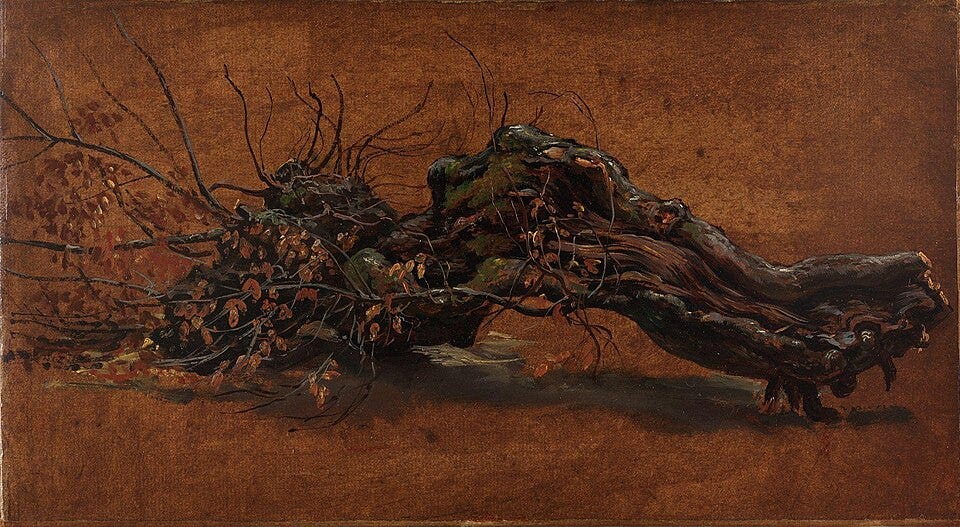
This word starts with a silent first letter. But at the dawn of its use, people pronounced it. They used to sound out other silent consonants that start common words, like knit or knob, knot or knuckle. (A fact I never ka-new.)
Those silent “k” words influenced the evolution of our mystery word. It once began with the same letter, though now we start it with a different consonant. According to etymological history, the original word arose during the Middle Ages, among Germanic tribes, to describe a crag on a cliff or a rugged outcrop. The word evolved to indicate a particular type of growth on a tree. In succeeding centuries, it gained a fifth letter and swapped its silent starter. Letters two, three, and four survived the ages unchanged. (To find that late-coming last letter, see the first letter of the perpendicular clue, “Harp-shaped constellation” [4].)
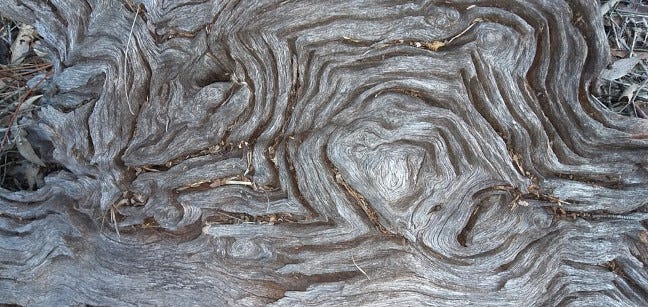
This bump on a log is also known (ka-nown) as a burl. It results when stress disrupts healthy growth to create a knot (ka-not). The tree grows beyond the stress and heals with a scar that reflects resilience. Burls create swirls, beautiful and strange, like the chemical clouds above a distant planet. The word “burl” unfurls all the way back to late Latin, when it once referred to a piece of wool.
Think you know the answer? Add it in the comments!
A few centuries after our mystery word emerged, Shakespeare resurrected it for modern English, re-shaping it to create an adjective by adding an “-ed” suffix in Measure for Measure. Isabella begs Angelo not to execute her brother, to find mercy and blame the sin, not the sinner, to aim so that “thy sharpe and sulpherous bolt splits the unwedged and -----éd oak than the soft myrtle.” True to form, Shakespeare delivered his artistic license with flair, accenting the “éd” to tack on a second syllable.
Another three hundred or so years later, a surfer on California beach found a curl, rode a wave, and re-invented the word as another adjective—this time adding a “-y” instead of Shakespeare’s “-ed.” The term for rough rocks and twisted wood transformed from tree to sea. Surfers applied it to turbulent waves, dangerous yet rewarding. Beyond the beach, this adjective form wove further into 1980s slang and came to bear both positive and negative connotations. Surfer Today illustrated its expansive and contradictory definition: “awesome, cool, excellent, wonderful,” and/or “grotesque, difficult, treacherous, complicated.”
Like the first letter’s pronunciation, the word’s use has since dropped. Today it has settled into a cultural niche, cropping up in the context of skateboarding, snowboarding; possibly in ironic, nostalgic use among Gen X.
Stressed and strong, chaotic and resilient, distorted and beautiful, bummed and stoked: From humble beginnings on a rocky crag, our word has traveled a twisted path.
Think you know the answer? Add it in the comments!
Sources:
Oxford English Dictionary
Primary image: Johan Christian Dahl (public domain)
Inline image: US Bureau of Land Management (public domain)
This post is totally gnarly, bro. (In a good way.)
I wasn’t smart enough to solve this until the surfer reference. I’m one of those Gen Y-ers that still drops the word, on occasion, to execute a perfectly poor caricature of a surfer bro. My audience—my immediate family—is usually unamused.